
Every eCommerce brand wants the same thing in 2026: more revenue and healthier margins. But too many are still chasing growth with blanket discounts and reactive campaigns that quietly eat into profits. The brands pulling ahead are the ones getting strategic about how they use promotions, where they invest in conversion optimization, and which channels they lean into for growth versus profitability.
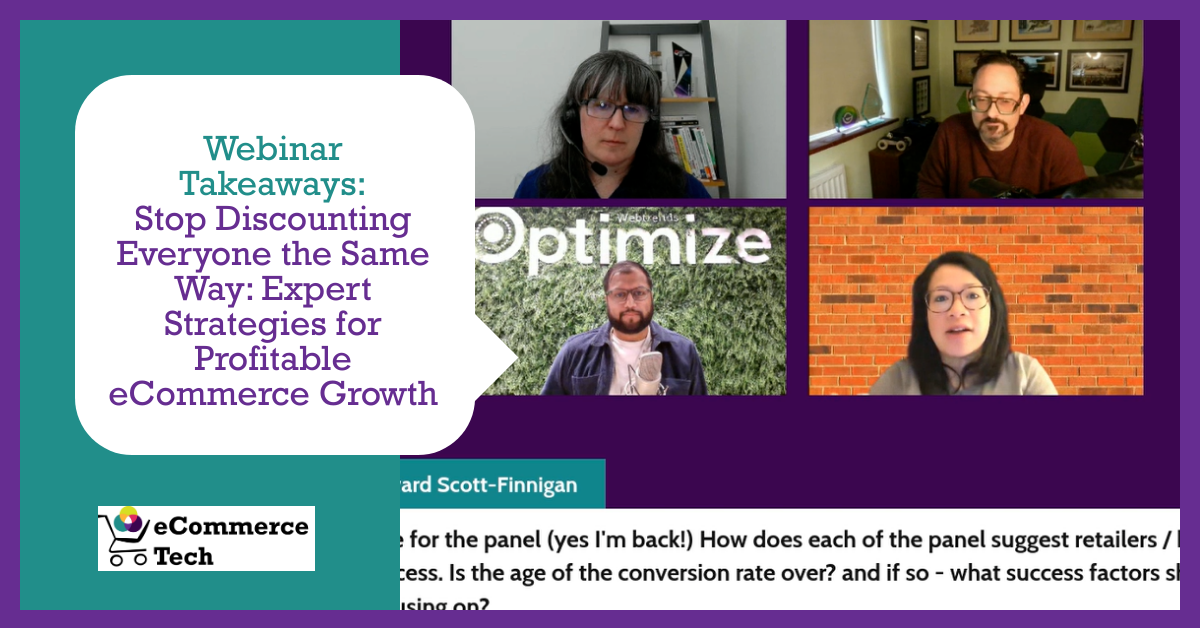
In the latest eCommerce Explored webinar, host Chloe Thomas sat down with three experts who live at the intersection of growth, profitability, and customer behaviour. The conversation covered everything from intelligent offer targeting to why your product team should be your best friend this year. Here are the insights worth acting on.
Meet the Panel
- Dan Bond: VP of Marketing at RevLifter, specialists in intelligent, personalised promotions that help brands drive conversions without damaging margins.
- Sandeep Shah: Director of Product and Co-Founder at Webtrends Optimize, with nearly 14 years of experience helping brands like Microsoft, HSBC, and Odeon Cinemas improve website conversion through A/B testing and personalisation.
- Jamie Lee: Founder and Principal of JME Labs, an eCommerce consultancy advising everyone from venture-backed startups to nine-figure brands. Previously held leadership roles at Nike, Walmart, Everlane, and Vital Proteins.
Why Blanket Discounts Are Bleeding Your Margins
Dan kicked off the session with a presentation on what he calls intelligent offers, and the core message was clear: the way most brands use promotions hasn't changed in 150 years, even though the tools available now are radically different.
The problem with site-wide discounts is simple. When you offer 20% off to every visitor, you're giving money away to people who would have paid full price, and you're still not reaching the people who will never buy, regardless. Research Dan shared from IMRG found that discounted products account for roughly 54% of revenue across the retail panel they surveyed. Promotions clearly work, but the margin damage and long-term brand expectations they create are real costs that many brands fail to measure.
The solution lies in targeting and testing. Instead of asking "should we discount?", the better questions are "who should see an offer?" and "what's the minimum incentive needed to change their behaviour?" RevLifter uses behavioural signals such as traffic source, browsing history, basket value, time on site, and purchase intent to segment visitors and serve different offers accordingly. A casual visitor needs a different nudge than someone who's had three items in their cart for two days.
Dan shared a practical example of offer sensitivity testing. When testing 5%, 10%, and 15% off email sign-up incentives with a real retailer, the highest discount naturally drove the most sign-ups. But when you dig into redemption rates, actual conversions, and average order value, 10% turned out to be the winning variant because it balanced volume with profitability. The takeaway: always measure beyond the headline metric.
Have a Clear Promotions Strategy (Before You Need One)
One of Dan's strongest points was about clarity. Too many brands don't have a stated position on discounting. He shared two contrasting examples: one was Radley, the premium handbag brand, which came to RevLifter knowing they were over-discounting and needed to pull back strategically without tanking conversion rates. The other was a successful brand that had never run a single promotion but recognised that with ambitious growth targets, they'd eventually need to start.
Both positions are valid. What doesn't work is having no position at all. Whether you're a premium brand that rarely discounts or a value-driven retailer that leans into promotions, the key is to be intentional about when and to whom you offer incentives. Dan's advice: Going cold turkey on discounts usually crashes your conversion rate. Pulling back gradually while getting smarter about targeting is the path that protects both brand and revenue.
Chloe reinforced this with a reference to a recent conversation with Gymshark's former CMO, who emphasised that scaling from eight figures upwards demands clarity on your approach to promotions, markets, channels, and products. If you're not making those strategic decisions, you're leaving growth on the table.
Separate Demand Capture from Demand Creation
Jamie delivered one of the session's most actionable insights for marketing teams. Her advice: make sure you're separating demand capture from demand creation in your marketing spend. Too many brands assume that scaling ad spend automatically equals more revenue, without examining where that money is actually going.
The classic trap is over-investing in branded search. If someone is already searching for your brand name, there's a level of brand defence worth playing, but spending 80% of your budget on keywords that would have converted organically is wasting money. Jamie pushes brands to scrutinise what's truly incremental versus what's cannibalising existing organic sales.
This also applies to channel mix. Google and Meta serve fundamentally different purposes: Google is primarily demand capture (people are already searching), while Meta excels at demand creation (reaching people who don't yet know they want your product). Understanding this distinction and structuring your budget accordingly is how brands get more efficient with their acquisition spending.
Her second piece of advice was equally direct: nail retention before you scale acquisition. If 50% of your first-time buyers never come back, you have a leaky bucket problem that no amount of top-of-funnel spending will fix. Focus on getting customers from their first purchase to their second, then third, then fourth, until they hit whatever threshold makes them a VIP customer for life.
Experiment with Everything (Not Just Your Website)
Sandeep's core message was refreshingly simple: experiment. Both in the mindset sense of being willing to try things and in the technical sense of running controlled A/B tests to find genuine data-driven answers.
The challenge he sees with many brands is that they're so consumed by the next campaign cycle that they never pause to test and learn. Fashion brands are perpetually launching the next season. Entertainment companies are promoting the next blockbuster. The campaign treadmill leaves no room for experimentation, so missed opportunities compound over time.
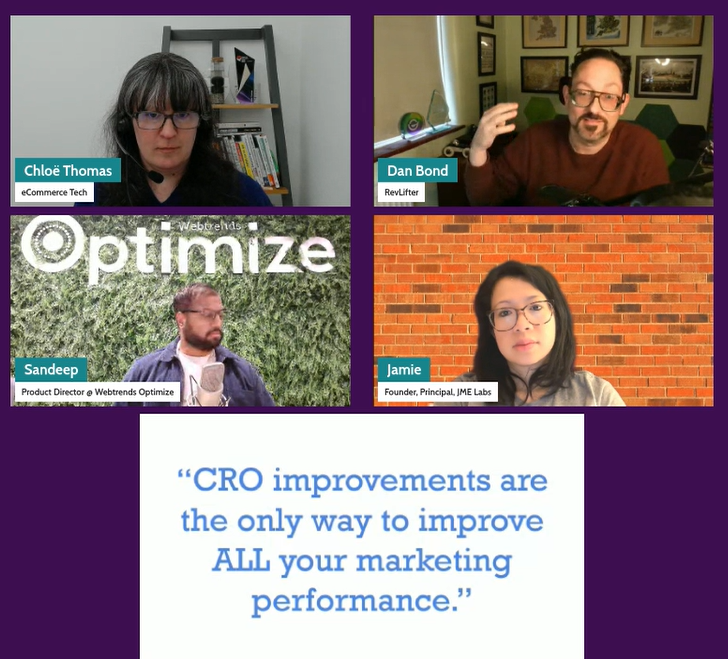
When the panel discussed whether CRO improvements can enhance all marketing performance, Sandeep was nuanced. For any digital, measurable channel, email, social, paid ads, or on-site experience, absolutely. Conversion rate optimization makes every marketing pound work harder. But he acknowledged that brand-level activities like billboard advertising or Super Bowl spots operate differently, and CRO's direct influence is limited in those channels.
What has changed in CRO over the past decade is the nature of the tests. The industry has moved well past button colour testing. Today, the high-impact work is around proposition testing: surfacing the right messages to the right visitors. Whether a customer needs reassurance about returns, size guidance, or delivery timelines, the value comes from understanding what each segment needs to hear and testing how best to present it.
Ignore Benchmarks, Segment Everything
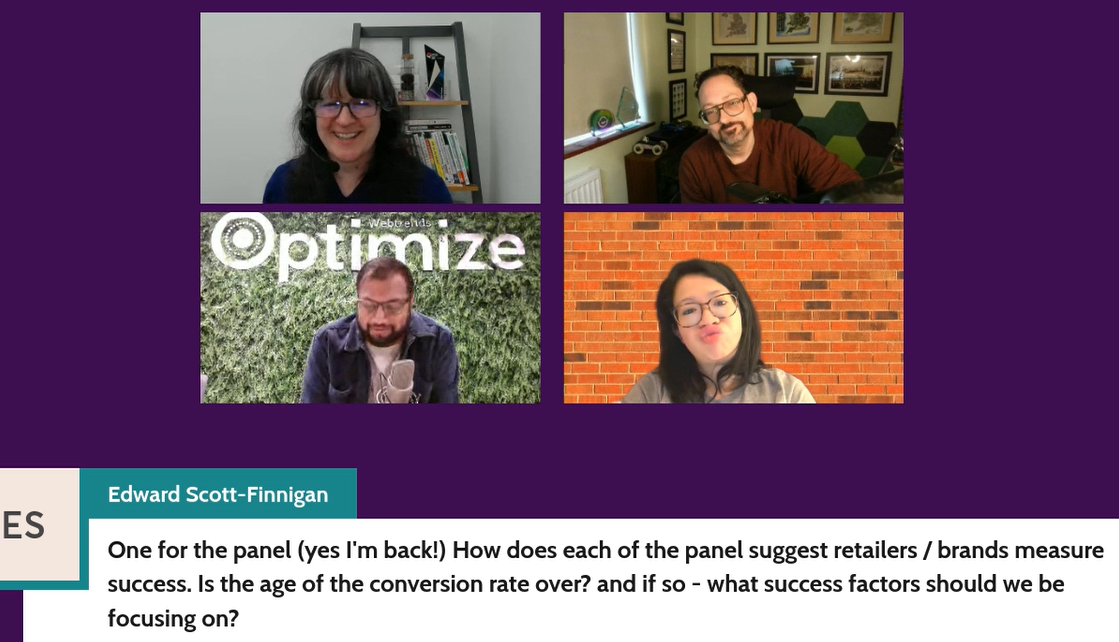
Edward Scott-Finnegan posed a great audience question: how should retailers measure success, and is the age of conversion rate over? Sandeep was emphatic: conversion rate remains a vital metric, but it's a measure of growth, not a destination. The moment you treat a 2% conversion rate as "mission accomplished," you've stopped improving.
His practical advice was twofold. First, ignore industry benchmarks entirely. A benchmark that lumps Louis Vuitton in with fast fashion brands tells you nothing useful about your own business. Second, segment relentlessly. Your site-wide average conversion rate is the sum of dozens of different audience segments glued together. Where individual segments underperform relative to what you'd expect, that's where the optimisation opportunities lie.
Jamie added two metrics she consistently recommends beyond the headline revenue and profit figures. Total average cost of sale (TACoS), which compares your total ad spend against total revenue rather than just attributed revenue, gives a clearer picture of marketing efficiency. The lifetime value to customer acquisition cost (LTV: CAC) ratio, particularly valuable for high-frequency businesses, reveals whether you're acquiring customers who will be profitable in the long run. She recommends waiting at least six months after acquiring a cohort before drawing conclusions on true LTV.
Dan brought it back to basics with a framing that cuts through metric overload: you're trying to sell more things, to more people, more often. Keep that in mind, and the right metrics to track will follow.
Yes, You Can Grow Sales and Profits at the Same Time
Chloe asked the panel directly: Is it possible to grow both sales and profit margin simultaneously, or do you always have to sacrifice one for the other?
Dan made the case through the lens of offer optimisation. If you understand your customer segments deeply enough, you can protect full-price revenue from high-intent buyers while using targeted incentives to convert fence-sitters. He went further: some retailers he's worked with have had hero products sell so well that RevLifter actually advised them to raise prices rather than discount them. Meanwhile, slow-moving inventory sitting in warehouses should be the focus of promotional spend. Matching supply data with demand signals is how you can maximise both sales volume and margin.
Jamie approached it through a channel strategy. If your DTC site is your profit channel and Amazon is your volume channel, accept those roles deliberately. Don't expect the same ROI from every channel. Instead, structure each channel's targets around its purpose in your overall business model. This clarity eliminates endless boardroom debates about whether marketplace margins are "good enough" and lets teams focus on execution within clearly defined goals.
Sandeep added that every combination of outcomes is possible: you can improve both sales and profit, improve one while hurting the other, or damage both. He used the example of own-brand versus name-brand products in retail, steering customers toward higher-margin own-brand alternatives while simultaneously fixing friction points that prevent additional purchases, which can move both needles positively.
Stay Connected to Your Product Team
Jamie's final takeaway was one that doesn't get discussed enough in eCommerce circles: stay connected to your product team. Not your digital product team, but the people making the physical products you sell.
Her reasoning is practical. You can optimise every touchpoint in your funnel, run brilliant paid campaigns, and nail your retention flows, but none of it matters if the product itself is getting one-star reviews. If customers aren't happy with what they're buying, no amount of eCommerce tactics will create sustainable growth.
The tactical approach she recommends is using digital channels as a rich source of consumer insights. Aggregate review data, search behaviour, and customer feedback, then share those insights with product development and R&D teams. This creates a feedback loop where the eCommerce team isn't just selling products, they're actively shaping what gets made next. Jamie summed it up neatly: be friends with your product partners, but not best friends.
Key Takeaways for 2026
- Adopt an experimental mindset. Don't just launch campaigns and hope they work; measure, iterate, and commit to personalisation. Treat your customers like individuals with different needs, goals, and concerns.
- Stay close to your product team. Feed consumer insights from digital channels into product development. If the product isn't right, no amount of marketing will fix it.
- Every activity should aim to change customer behaviour incrementally. Ask yourself: is this action genuinely creating new sales, or just capturing behaviour that would have happened anyway? Focus on high-impact changes and make sure you can measure whether they're actually working.
Want to watch the full conversation? Catch the replay on YouTube.
Don't miss out on future sessions by signing up for eCommerce Explored to get access to upcoming live webinars and replays.
Sponsor Note: RevLifter sponsored this webinar session. A free 90-day trial is available at revlifter.com.