
Adding a sales channel sounds simple until you actually do it. Then you find out the product data sitting neatly in your store isn't the product data Nordstrom wants, Amazon wants, or Target wants. Different field names. Different category trees. Different image rules. Different ideas about what counts as one product.
So the work starts. Someone exports a spreadsheet, reformats it, uploads it, waits, gets half of it rejected, and starts again. Six weeks later you are live on one new channel, and nobody wants to talk about doing the next one.
Channel management software exists to stop that cycle. It takes one source of product truth, reshapes it for each channel, pushes it out, then keeps prices, stock and orders in step afterwards. Get it right and adding a marketplace becomes a decision rather than a project.
What Channel Management Software Actually Does
Four jobs sit underneath the label:
- Listing creation. Turning your catalogue into listings that meet each channel's rules on the first attempt instead of the fourth.
- Data transformation. Mapping your fields, categories and attributes to whatever the channel calls them.
- Syndication. Keeping price, stock and imagery in sync once listings are live, so you are not selling stock you no longer have.
- Order flow. Pulling marketplace orders back into your systems, and pushing fulfilment and refunds back out.
Some tools do all four. Some do one very well and expect you to handle the rest.
Channel Manager, Feed Tool, or Marketplace Integrator?
These three terms get used as if they mean the same thing. They do not.
- Feed management tools build and optimise product feeds, mostly for advertising channels like Google Shopping and Meta. The output is a file or an API push, and the tool's job ends there.
- Marketplace integrators connect you to specific marketplaces and handle listings, offers, and orders. Some never build a feed at all because the channel has its own API.
- Channel management platforms in the broad sense cover both, plus reporting, repricing, and sometimes fulfilment and retail media.
Worth knowing before you shortlist, because a tool that is brilliant at Google Shopping feeds may have nothing useful to say about getting approved on Macy's.
Where It Sits in Your Tech Stack
Channel management sits between your source of truth and your channels. Your source of truth is usually your store platform, a PIM, or an ERP. Everything downstream should read from it rather than keep its own private copy of the catalogue.
Two integration questions decide most of this:
- Where does product data live, and can the tool read it directly? A tool that plugs into Shopify natively saves you a mapping project. A tool that expects a nightly CSV means somebody owns that CSV forever.
- Where do orders need to land? If marketplace orders do not flow into the system your warehouse actually works from, you have moved the manual work rather than removed it.
Stock accuracy is the one to be strict about. Every channel needs the same number at the same moment, or you will be cancelling orders and damaging your seller metrics on the very channels you just worked so hard to join.
Standalone or Bundled?
Bundled channel management, the kind that arrives inside a bigger commerce suite, is convenient and rarely best in class. Standalone tools tend to go deeper on the channels they cover, and are easier to replace when your channel mix changes.
Your stage matters here too. A brand selling on one marketplace with 200 SKUs doesn't need enterprise infrastructure, and buying it early means paying for capability you won't use for three years. A brand running dropship programmes with retail partners across several countries will outgrow a lightweight tool almost immediately. Be honest about which one you are, not which one you would like to be.
Our Choices for the 3 Best Channel Management Software Tools for eCommerce
Channel management is not one market. It is at least three, and the right pick depends entirely on where you sell.
We have chosen three tools that solve the problem in completely different ways:
- Osello for fashion brands on Shopify getting live fast on US department store marketplaces
- Rithum for large brands and retailers who need listings, dropship, and retail media in one place
- ZonGuru for Amazon sellers who want depth on one channel rather than breadth across many
Read on for what each one does well and where it stops. Or see every marketplace and omnichannel tool we track in the Marketplaces & Omnichannel category of our directory.
Osello
Osello is built for one specific, genuinely awkward job: getting a Shopify fashion catalogue live on US department store marketplaces. Nordstrom, Macy's, Bloomingdale's, and Target Plus are the channels it was designed around. It is the youngest tool on this list by some distance, an AI-native marketplace listing specialist rather than a general channel manager, and it is the only one here that was built for apparel from the first line of code.
- Tech Stack Type: Standalone marketplace listing and sync platform that sits on top of Shopify
- Best for: Start Up / Mid-Sized fashion and apparel brands
- Pricing: Plans start at $299/month billed annually, with a free tier for up to 100 live SKUs and one marketplace. See Osello's pricing page for current tiers.

What Makes Osello Great?
Apparel breaks most channel tools, because most channel tools were designed for general merchandise. A dress with eight sizes in four colours is one product to a shopper, thirty-two SKUs to your store, and something different again to every retailer you list it with. Osello was built around that problem, not around it.
What that looks like in practice:
- One Shopify style becomes the right variant structure on each channel, with colourways grouped and size runs kept intact.
- Images are handled per marketplace: backgrounds whitened, crops corrected to each retailer's product page, alternate shots ordered.
- Rejections get read, fixed, and resubmitted automatically rather than sitting in someone's ticket queue.
- You preview and approve drafts before anything goes live, then sync stays on
Speed is the real pitch. Osello's published case studies report brands going from install to first live listing in five days, with 93% first-submission approval, and one brand going live on Nordstrom in three weeks after seven months of trying on its own. Treat vendor case studies as vendor case studies, but the pattern is consistent enough to ask about in a demo.
There is also a sensible answer on returns. Fit returns restock in Shopify, and that stock goes back out to every marketplace, which matters more in fashion than in almost any other category.
One more thing to know if you are already on another platform: Osello supports importing existing listings from Mirakl and other providers, so migrating doesn't mean starting from zero.
The downside: this is a specialist, and it behaves like one. If you sell general merchandise, Amazon is your main channel, or your catalogue lives outside Shopify, Osello isn't the tool. You're trading breadth for a data model that understands how clothes are actually sold.
AI Summary of Customer Reviews of Osello
Osello is new enough that it hasn't built a review corpus on G2, Capterra, or Trustpilot, so there is no aggregate score to quote. Publicly, there are named customer case studies covering brands including Universal Standard, Furniq UK, and The Noli Shop, all pointing to the same two themes: time from install to live listing, and the end of manual spreadsheet uploads. One operator sums it up as not being able to imagine going back to the old way of working. With a young vendor, the sensible move is to ask for a reference customer at your catalogue size and check the approval rate claims against their real numbers.
Rithum
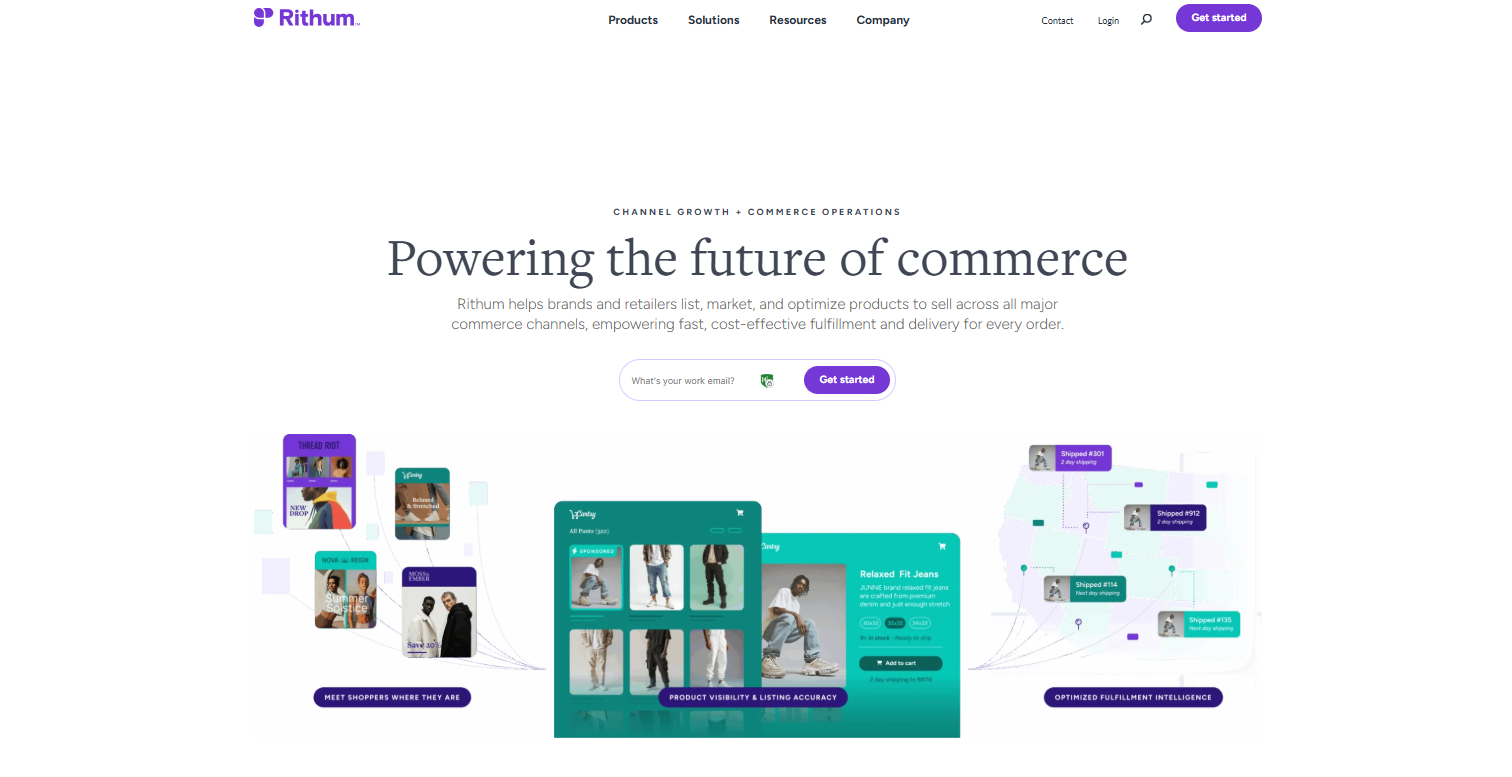
Rithum is the opposite bet. Where Osello is deliberately narrow, Rithum tries to cover the whole commerce operation, and it sells to both sides of the marketplace relationship: brands listing products and retailers running the marketplace. The brand name is recent, but the software underneath it is not. CommerceHub goes back to 1997, and ChannelAdvisor to 2001, and the two came together under the Rithum name in December 2023. This is the enterprise end of the category.
- Tech Stack Type: Enterprise commerce platform, multiple modules under one contract
- Best for: Enterprise / larger Mid-Sized
- Pricing: Quote based. Independent reviewers report entry points around $2,000 a month plus a share of GMV, on annual or multi-year terms.
What Makes Rithum Great?
Scale, mostly. Rithum was formed from the merger of CommerceHub, ChannelAdvisor and Dsco, two of the longest-running names in channel management, brought under one brand in December 2023. The network reaches more than 420 marketplaces and retail sites and processes around $50 billion in annual GMV across 40,000 brands, retailers and suppliers.
Where that scale earns its keep:
- Listings across hundreds of channels from one interface, with transformation rules that adapt your content to each destination's requirements
- Dropship and private marketplace machinery, which is the part no mid-market tool replicates. It serves brand and supplier channel management alongside retailer dropship and marketplace operations.
- Retail media tied to listing data, so advertising decisions are made against what is actually live and in stock
- AI assistance for the grunt work, including Magic Mapper for auto-categorising products into marketplace taxonomies and RithumIQ for pricing recommendations
- Managed ERP integrations to SAP, NetSuite and Microsoft Dynamics, plus a certified partner connector network
The channel roster keeps moving too. Recent additions include a Temu partnership that gives Rithum users bulk publishing and two-way inventory and shipment syncing, plus a Best Buy Marketplace integration.
The downside: cost and complexity, and they are related. Percentage-of-revenue pricing means your bill grows with your success, multi-year contracts mean switching is painful, and the platform takes real training to use well. Reviewers consistently call it the right choice for brands around $50M+ GMV and the wrong one below mid-market scale. If you want transparent pricing and a fast self-serve setup, look elsewhere.
AI Summary of Customer Reviews of Rithum
Rithum holds 3.9 out of 5 on G2 from 113 reviews and 3.8 out of 5 on Capterra from 61 reviews, an aggregate of 3.9 across 174 verified reviews. That score split tells the story. Reviewers rate it well on what it does: centralised listing across many marketplaces, dependable inventory syncing, order and billing handled in one portal, and strong reporting. G2 users describe navigation as intuitive once you are in it, with little lag on inventory adjustments and order management. Complaints cluster around price and the effort to get started. A recurring note is that it takes considerable training to find all the features, and support quality draws mixed reviews, with G2 scoring support quality at 7.3 out of 10. Read as a whole: powerful, expensive, and not something you buy without implementation resources behind it.
ZonGuru
ZonGuru takes the third approach: ignore multichannel entirely and go deep on one. If Amazon is where your revenue lives, a tool that understands Amazon properly may be worth more to you than one that touches twenty channels lightly. It is an established name rather than a new one, with a public review history stretching back to 2020 and around 10,000 customers on our directory listing, and it sits in the Amazon Seller Tools corner of the market rather than the channel management platform corner.
- Tech Stack Type: Standalone Amazon seller toolkit
- Best for: Start-up / Mid-Sized
- Pricing: See our full listing about ZonGuru for pricing information
What Makes ZonGuru Great?
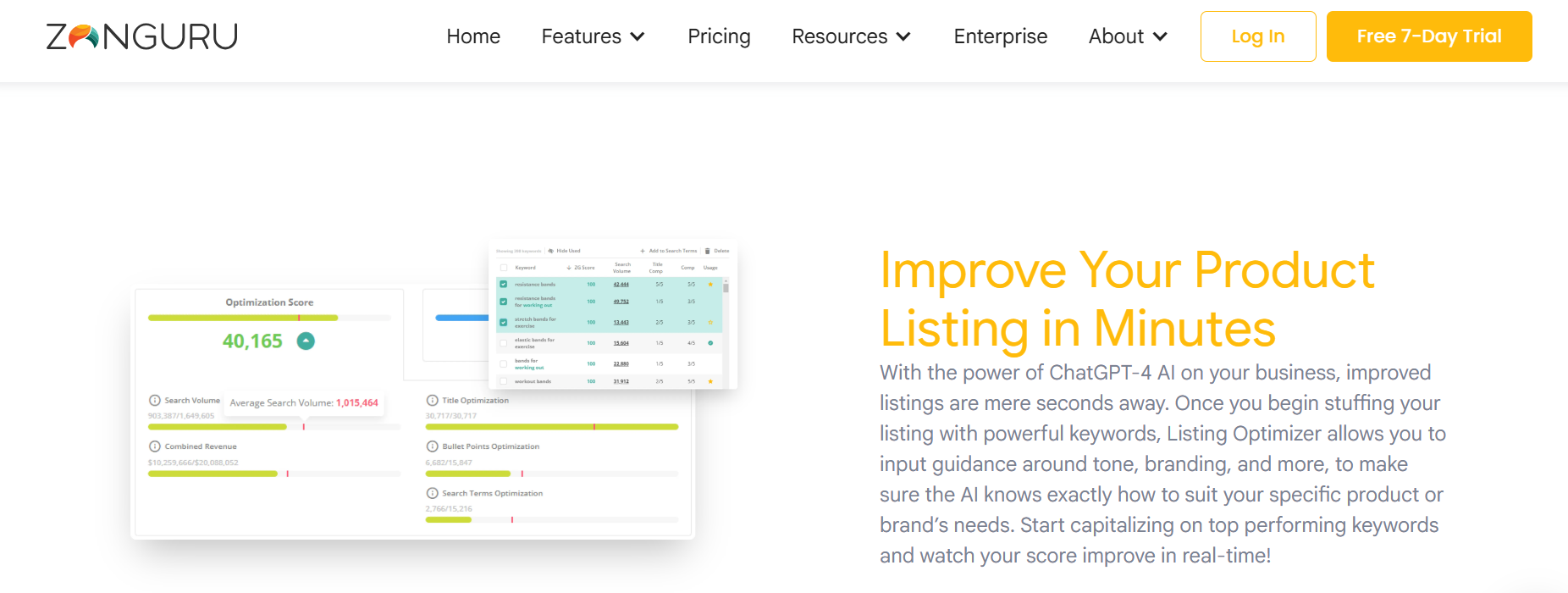
It covers the full Amazon working week, not just one slice. Product research, keyword research, listing optimisation, review management, and profit tracking all sit in the same place, which is unusual at this price point.
The tools people actually use it for:
- Niche Finder and Sales Spy for finding product opportunities and tracking what competitors are selling
- Keywords on Fire and Keyword Tracker for ranking work
- Love-Hate, which reads competitor reviews and pulls out the recurring praise and complaints. Genuinely useful for product development and for writing copy that answers real objections
- Business Dashboard for profit, alerts, and IP monitoring across your SKUs
The differentiator right now is Helix AI, ZonGuru's agentic listing builder. It writes listings tuned for Amazon's COSMO algorithm and Rufus AI, which larger suites don't currently match. As Amazon search shifts towards AI-led discovery, that focus is worth paying attention to.
Coverage spans the US, UK, Canada, Germany, Italy, France, Spain, India, Australia, and Japan, so international Amazon sellers aren't locked out.
The downside: it is an Amazon tool, not a channel manager. It doesn't sync your catalogue to Walmart, Target, or your own store, so if you're running a multichannel business, ZonGuru is one piece of the stack rather than the stack. Pricing also steps up in wide SKU bands rather than smoothly, so moving from 20 to 21 active SKUs jumps you a full tier. Check where you sit against those bands before committing.
AI Summary of Customer Reviews of ZonGuru
ZonGuru holds 4.2 out of 5 on Trustpilot from 142 reviews. Reviewers repeatedly single out the same strengths: data they trust for product research, a dashboard that makes daily profit and PPC performance readable at a glance, and support that responds quickly and knows the product. The negative reviews are narrow and consistent, and almost all focus on billing rather than the software. The recurring complaint is auto-renewal with no warning and a tight refund window, which the vendor answers publicly by pointing to its self-service subscription terms. Its Capterra profile carries only a single review, so treat that 1.0 score as too thin to be meaningful either way. Independent reviewers who have tested the toolkit hands-on score it in the 8 out of 10 and 7.5 out of 10 range. The practical advice: set a calendar reminder before your renewal date, and the main source of frustration disappears.
Find Your Perfect Channel Management Software
Here are three picks from the hundreds of tools in this category. You can find plenty more in our tech directory, starting with the Marketplaces & Omnichannel category.
Quick decision guide:
- Fashion brand on Shopify chasing US department store marketplaces: Osello. The apparel data model and the speed to first live listing are the whole point, and nothing general-purpose comes close on that specific job.
- Large brand or retailer running listings, dropship, and retail media: Rithum. The breadth is real, and so is the invoice. Worth it when marketplace revenue is already significant, and you have people to run it.
- Amazon is the business: ZonGuru. Depth on one channel, at a price that leaves budget for stock.
- Not sure which channels are next? Don't buy yet. Pick the next channel first, then buy the strongest tool for it. Buying a platform in the hope it will make the strategy obvious is how brands end up paying for capability they never switch on.
One last thing. The software is rarely the expensive part of channel expansion. The expensive part is the weeks your team spends fixing rejected listings and reconciling stock. Price your options against that cost, not against each other.
Looking for a deal? Check our Deals section, as marketplace and channel tool offers come through regularly.
Plus, these blogs will help you make the right call: