
%20(1).jpg)

What does it actually take to win in eCommerce this year? It's a question that keeps brand owners up at night – and honestly, even the experts admit there's no simple answer anymore.
Some years back, the advice was straightforward. Do this, this, and this, and you'll be fine.
This year? Not so much.
Host Chloe Thomas kicked off the first eCommerce Explored webinar of 2026 with a confession: she wasn't entirely sure what brands needed to hear. The landscape has shifted. AI is everywhere. TikTok has rewritten the rules of discovery. And consumers? They're tightening their belts while scrolling faster than ever.
So instead of pretending to have all the answers, Chloe did something smarter. She assembled a panel with wildly different perspectives – not to argue, but to give eCommerce brands as many angles as possible on the question everyone's asking: what's actually going to work this year?
What emerged wasn't a neat checklist. It was messier than that. And honestly, far more useful.
Meet the Panel
- Ashu Dubey is the Co-founder and CEO of Alhena AI, an agentic commerce platform that helps brands use AI to improve customer experience and conversion.
- Ian Sells is the founder of Million Dollar Sellers, a global network of over 700 multimillion-dollar eCommerce brand owners, and the creator of Join Brands, which connects brands with influencers and creators at scale.
- Sian Conway-Wood is Senior Managing Partner at 181st Street Communications, a behavioural growth consultancy that helps brands grow through consumer psychology and human behaviour.
.
TikTok Is the Growth Lever Right Now (But You Can't Half-Commit)
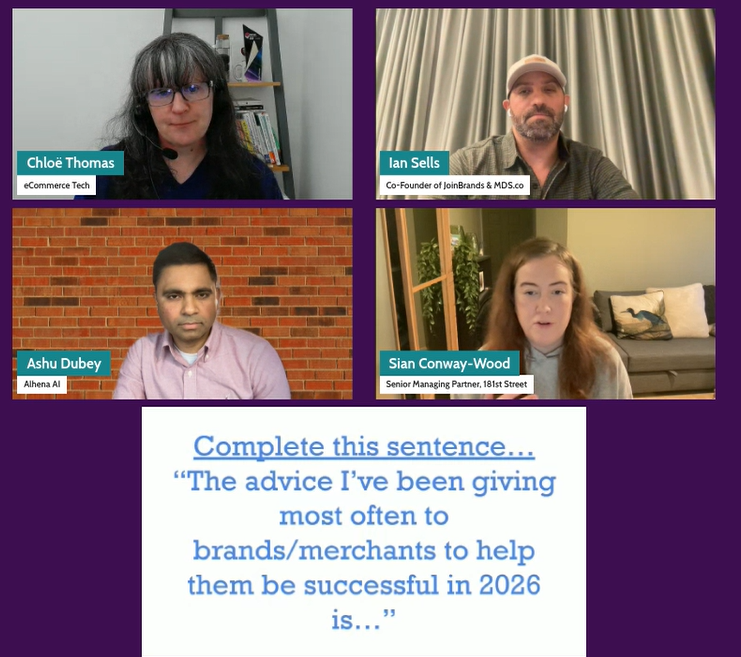
When Chloe asked the panel what advice they've been giving brands, Ian didn't hesitate.
"TikTok is helping brands scale tremendously fast, faster than we've ever seen before through any other channel," he said. "And organically, as well as paid ads."
The platform delivers on multiple fronts – marketplace, influencer partnerships, affiliates, organic reach, and advertising. It's not just one channel; it's an ecosystem. And importantly, success on TikTok tends to inflate performance across other channels too.
But here's where Ian's advice gets real: you can't dabble.
"The brands that are really successful on TikTok are posting a lot and working with tons of creators all at one time," he explained. "You can't just dip your toe in."
For brands in countries without TikTok Shop, there's still an opportunity. You can drive traffic to your Shopify store, run ads like you would on Meta. It won't match the volume of having full TikTok functionality, but it works. The key is committing to the platform properly – or not bothering at all.
Your Customers Aren't Thinking. They're Feeling. (And That Changes Everything)
Sian brought a perspective that reframes everything else the panel discussed. It's the kind of insight that makes you rethink your entire marketing approach.
"We all like to think that when we're making buying decisions, we are these wonderful higher beings with cognitive reason," she said. "Actually, it's our reptile survival brain. We buy because we are reducing risk, we are ticking certain needs within us."
Those needs? Social status. Acceptability within the herd. Basic survival instincts dressed up in modern clothing.
Here's the part that really lands: about 90% of the time, customers operate in what psychologists call "system one" thinking. It's fast, intuitive, and emotional. They're not carefully weighing your product features against competitors. They're making gut decisions about whether something feels right.
And if their analytical "system two" brain switches on?
"Nine times out of ten, they're going to talk themselves out of purchasing anything, let alone from your brand," Sian explained.
The takeaway isn't to abandon good creative or compelling copy. It's to understand that your audience isn't experiencing it the way you imagine. They're reacting on a different level entirely – and your job is to feel right before you can persuade logically.
AI: Stop Watching from the Sidelines
Ashu offered a framework for thinking about AI that cuts through all the noise. It's simple, but it actually helps you figure out where to focus.
Defensive AI is about efficiency – using technology to cut costs and save time. Think about automating product page descriptions, streamlining repetitive tasks, and reducing the hours your team spends on things that don't require human judgment.
Offensive AI is about driving revenue. That splits into two parts: discoverability (appearing in ChatGPT, Gemini, and Perplexity searches – the new SEO battleground) and conversion (using AI-powered shopping assistants on your own website to guide customers to purchase).
His advice was direct: "If you are on the sidelines, you're missing out big time."
Even if you haven't found the perfect vendor, start somewhere. Crawl, walk, run. The learnings compound, and waiting for perfection means falling behind competitors who are experimenting right now.
Where should you begin? Customer support is the lowest-hanging fruit.
"It's very mainstream. Almost risk-free," Ashu said. "And once you deploy any AI tool, there are certain things that come with it – how to train an AI, how to prompt it, how to control it, how to make it speak like your brand."
Those skills transfer to every other AI application. Start with support, learn the fundamentals, then expand from there.
What Brands Should Actually Stop Doing This Year
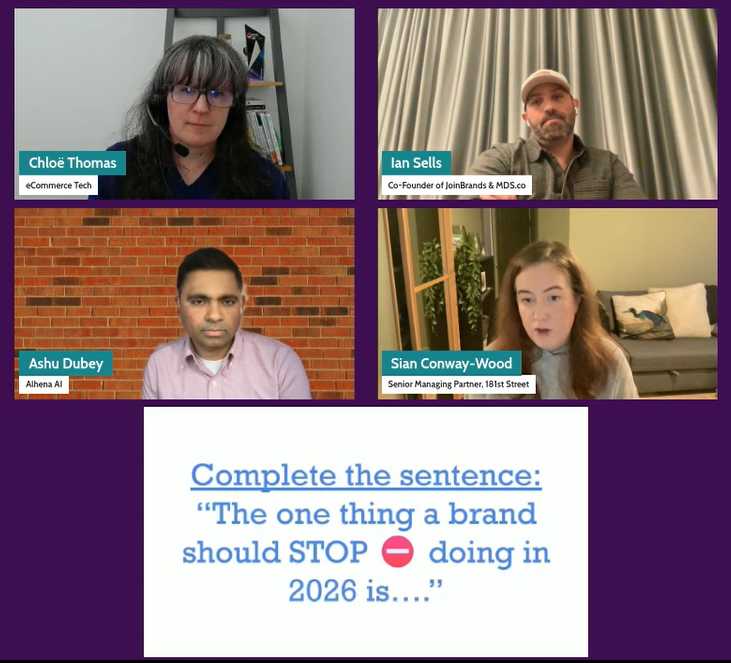
Chloe pushed the panel on something most eCommerce conversations skip over: what should brands kill off? If you're going to focus on growth, you need to create space for it – in budget, in bandwidth, in mental energy.
Ian's take: Be ruthless about ROI. "Where do I see the most bang for my buck and my time? Put more energy into that." If social media content takes hours but generates little revenue, maybe your energy would be better spent elsewhere.
Sian's warning: Stop killing off your distinctive brand assets while chasing viral moments.
"Because TikTok has become so popular, there's been a real swing to chasing trends, jumping on the trending sound, doing the latest meme," she explained. "And in doing that, very small, very reactive teams are forgetting to bring in the thing that makes their brand distinctive."
The data supports this: about 80% of buying decisions come down to which brand is most familiar in that category when someone's ready to purchase. If your content is all trending audio and nothing distinctive, what will customers actually remember?
Sian pointed to Marks & Spencer as a brand doing this brilliantly – bringing Percy Pig and Colin the Caterpillar into every trend, so the content feels current, but the brand stays front and centre.
Ashu's caution: Stop delegating your brand identity entirely to platforms.
With shopping agents emerging in ChatGPT and Google, the temptation is to let platforms handle everything. But Ashu warns: "You need to think of platforms as a discovery layer. How do you own your relationship with customers so they become repeat purchasers?"
If ChatGPT starts recommending your products alongside three competitors, how do you control how your brand appears? That's the question brands need to be pondering.
The Uncanny Valley Problem in AI Creative
Sian raised something brands deploying AI for creative work really need to understand: the "uncanny valley" effect.
"This is actually a real deep-seated survival instinct within us," she explained. "It's when things look a little bit too perfect, or it looks human, but it's not quite. It's why we find realistic dolls really creepy."
Her point isn't to avoid AI-generated creative entirely. The data from the Coca-Cola Christmas advert (recreated with AI) showed customers couldn't tell the difference and didn't particularly care.
But you need to avoid triggering that sense of wrongness. Too polished, too perfect, and you'll create backlash instead of a connection. It's a fine line, and brands experimenting with AI creative need to understand the psychology behind it.
Quality Over Quantity (Especially for Content and SEO)
One audience member asked about a dramatic drop in Google organic traffic – likely tied to AI-generated content. Ashu, who led SEO at LinkedIn before founding Alhina, was direct about what's happening.
"AI content, per se, is not the problem. Low-quality content is the problem."
The tendency with AI has been to scale quantity without worrying about quality. Churn out pages. Flood the site with content. And Google has noticed.
"It takes a really long time once Google penalises you to come out of that hole," Ashu warned. "It's far more work to come out of that hole than to not go in."
The good news? Google actually wants you to use AI to create high-quality content. The issue isn't the tool – it's how brands are using it. Focus on the metrics that matter: dwell time, click-through rate, and actual engagement. If AI helps you create better content, use it. If it's just helping you create more content, be careful.
The Economic Reality (And How to Navigate It)
Sian brought a sobering but practical perspective on selling in challenging economic times.
"Disposable income becomes tighter, and that is affecting people's purchasing behaviour," she said. "Our impulse spending thresholds increase when money is tight. You're going to spend less on impulse purchases."
So how do you cut through?
"It's about lifetime value. Once you've won that customer – and your cost of acquisition is going to be more expensive – keeping that relationship with them is crucial."
Her framework is simple but powerful: "Assume that it's a no and that you have to win them over with a yes by de-risking the purchase. What are all the possible reasons your customer could say no? Then address those at every stage of the relationship."
Don't try to convince people to spend when they're feeling cautious. Instead, remove the barriers that make them hesitate.
Final Takeaways: What's Actually Going to Move the Needle?
Each panellist offered their parting wisdom for brands looking to succeed in 2026.
Ian: "Take advantage of the things that are going to produce the highest ROI for your business. Take advantage of tools that save you time and money and help you create new levers. Brands in MDS are using AI across their businesses – from creating new products to understanding customers to scaling operations. Focus on what works and actually take action."
Sian: "The only way to know what you should do for your business comes from deep knowledge of who your customers are, deep knowledge of the customer journey, and the data within your business showing what's working and what isn't. Set your strategy based on what you know to be true, and let that be your guiding star. You can try trends and new platforms, but do it with a plan so you don't burn out."
Ashu: "If I could make people believe in the power of how capable AI actually is – it's unbelievable if you get it right. All brands are leaving maybe 5-10% of revenue on the table just by not using a shopping agent on their websites. We recently published a case study with Victoria Beckham where they drove over 10% revenue and 20% average order value using a shopping agent. If there's one thing that's going to move the needle in 2026, it's how you leverage AI across all functions."
Watch the Full Session
The conversation covered even more ground than we could fit here – including audience questions about tech stack optimisation, AI tools that actually deliver results, and how to prepare for AI-powered shopping through ChatGPT and Google.
Watch the full webinar replay here.
Don't Miss Our Next Session
Our next eCommerce Explored webinar takes place on 18th February 2026, where we'll be diving into profits – promotions, personalisation, and conversion rate optimisation strategies to improve your bottom line.
Sign up for future webinars at eCommerce Explored.
Sponsored by Alhena AI – the agentic commerce platform helping brands drive revenue through AI-powered shopping experiences.

.png)