
The email marketing app market has changed more in the past 12 months than in the several years before it. Mailchimp removed automations from its free tier and cut the contact limit to 250 subscribers. MailerLite halved its free plan from 1,000 to 500 subscribers. Flodesk discontinued its unlimited plan. Yotpo exited email and SMS entirely, leaving merchants mid-contract looking for alternatives. For many, these changes reopened a decision they thought was settled.
But free plan cuts are just the most visible sign of a broader shift. Platforms that were once easy defaults now come with real tradeoffs for smaller brands, while some Shopify-native tools have improved to the point where they can cover most ecommerce needs at a lower cost and with less complexity.
The right email marketing app for Shopify in 2026 isn’t the one with the most features or the longest free trial. It’s the one that fits how you send, covers the automations you actually need, and stays manageable as you grow.
This guide breaks down the key decisions first, then walks through a shortlist of apps that hold up as your store scales.
5 Questions to ask when choosing an email marketing app for Shopify
How deeply does it integrate with Shopify?
“Integrates with Shopify” covers an enormous range. At the shallow end, it means a basic contact sync, email addresses pulled from your customer list. At the deep end, it means real-time behavioral triggers: a customer abandons checkout, completes a purchase, and goes quiet for 60 days. Each of those events can fire an automated sequence without anyone pressing send.
Shallow integration forces workarounds, manually exporting segments, uploading lists, and adding product information to email campaigns by hand. Before committing to a platform, ask: can it natively trigger flows from cart abandonment? Can it pull live product data into email templates, or do you have to upload it manually?
Which automations do you actually need?
The flows that drive the most revenue for Shopify stores aren't exotic: welcome series, abandoned cart reminders, post-purchase sequences, and win-back campaigns. Almost every paid app on the market handles these four.
The temptation is to choose the platform with the most sophisticated automation builder. Resist it. Complexity has a real cost: setup time, learning curve, ongoing maintenance, often owned by one person who is also running the store. “Best in class” that takes a month to configure loses to “good enough” that ships this week.
Does the pricing model match how you send?
Most platforms fall into one of two camps: contact-based and contact-agnostic. Contact-based pricing means your bill grows as your list grows, even if those subscribers aren’t generating revenue yet. This becomes expensive quickly for stores investing in list growth. For example, you can start at $30 per month for storing up to 1,000 contacts, but once your list reaches 3,500 contacts, the cost jumps to $100 per month.
Contact-agnostic pricing shifts the risk in the opposite direction: you pay based on your sending volume. That makes it more cost-efficient for brands that build large lists but email selectively.
The right fit depends on how you send. If you email your full list frequently, contact-based pricing is predictable. If you grow your list aggressively but send emails occasionally, or to smaller segments, contact-agnostic models work in your favor at scale.
How far does segmentation need to go?
For most Shopify merchants, a handful of basic filters covers the majority of use cases: customers vs. subscribers who haven't purchased, recent buyers, high-value customers, and inactive subscribers. Sending different messages to these groups, rather than the same email to your entire list, is where most of the performance gain comes from. You don't need machine learning to do it.
What you do need is a platform that builds these segments from Shopify data, purchase history, order value, and last purchase date, without manual exports.
Can a lean team run it?
Every platform on this list is manageable for a lean team, but the time investment varies significantly. Consider: how fast can one person launch the first three automations? Or: are there pre-built templates you can adapt to your branding, or will you have to build and design everything from scratch?
One more factor worth checking: deliverability. According to the EmailToolTester report, the average deliverability rate is 83.1%, meaning roughly 1 in 6 emails never reach the inbox. Most established platforms handle this well, but differences emerge in list-hygiene tools and sender-reputation safeguards. For a lean team, these should work automatically, not require specialist management.
Email marketing apps for Shopify worth considering in 2026
Klaviyo
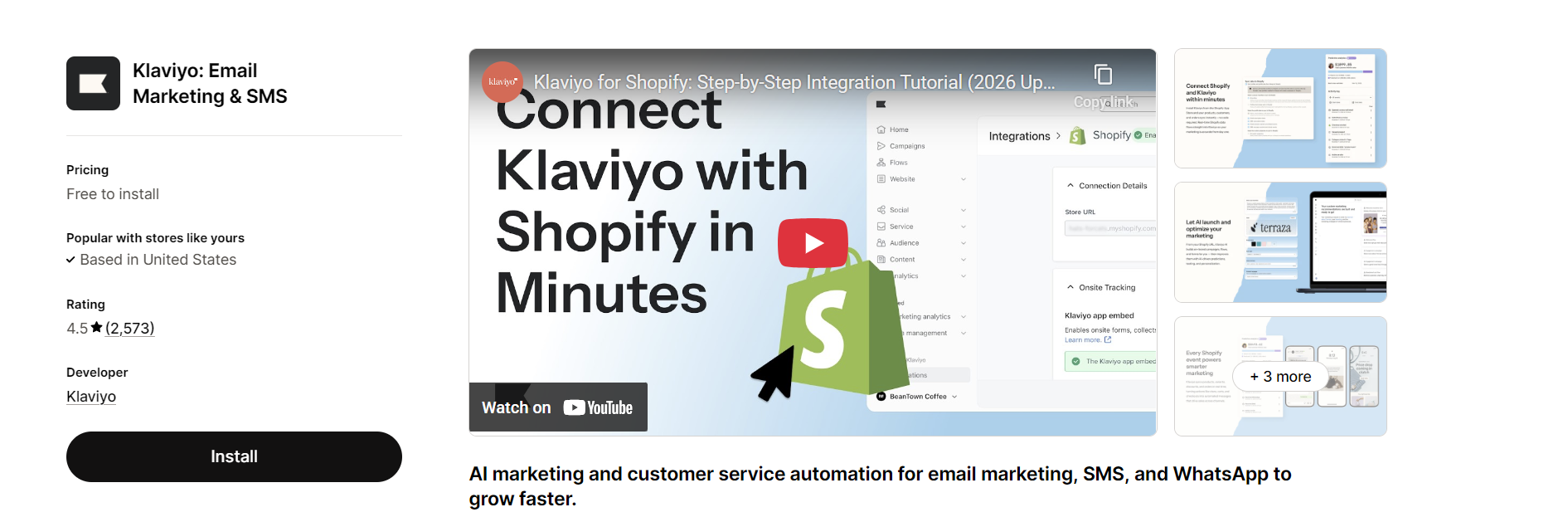
Klaviyo is the benchmark for ecommerce lifecycle marketing, with the deepest Shopify data sync, the most sophisticated automation, and best-in-class segmentation and personalization. For stores where email is already a primary revenue channel, it's hard to argue against.
Two things are worth knowing before committing. The pricing reflects the value, but it scales steeply. As your list grows, your costs increase, whether or not those subscribers are actively driving revenue. For fast-growing stores, it’s common to hit a point where email spend outpaces the revenue the channel is generating, unless segmentation and monetization are already dialed in. For stores that get there, it tends to stay the platform they don't replace.
Pricing: Free up to 250 contacts and 500 sends. Paid plans start at $20/month for 251–500 contacts and scale with list size.
Shopify Messaging (former Shopify Email)
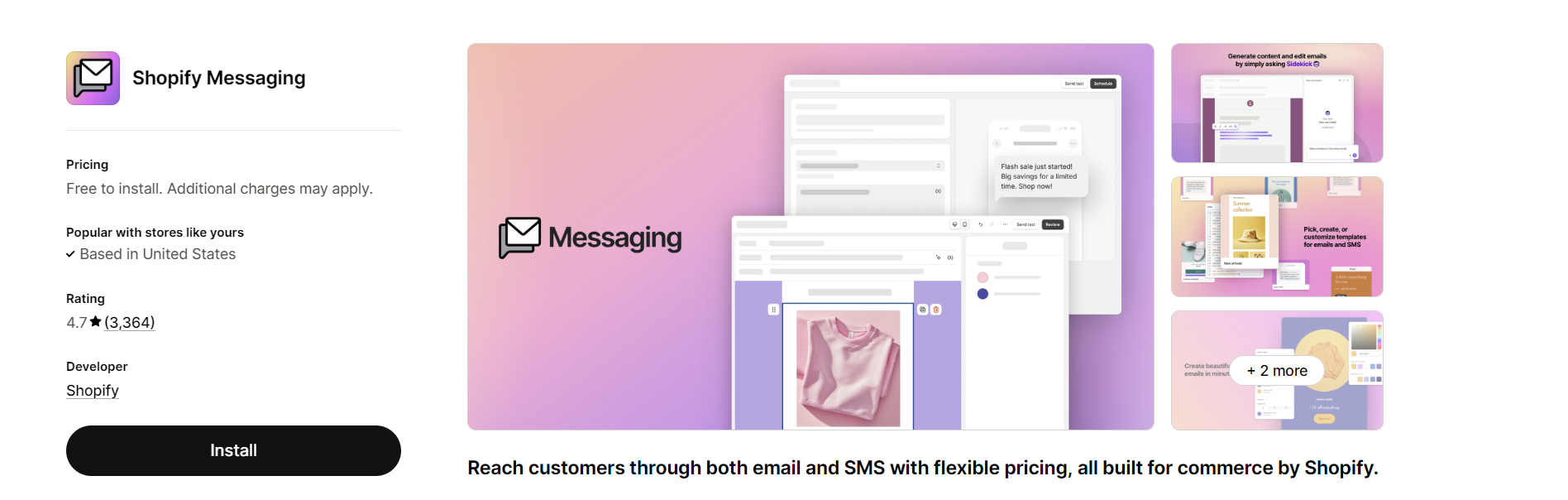
Shopify Messaging is the zero-friction starting point: no separate login, no migration, no setup beyond what you already do in your Shopify admin. Products, customer data, and store branding are pulled in automatically, which means your first campaign can go out in minutes.
The tradeoff is depth. Template customization doesn't go far, and for more advanced automations, you can connect Shopify Flow, another native Shopify app that's free to use. For stores that want to validate the email channel before investing in a dedicated platform, it works very well. For stores ready to run serious lifecycle marketing, it quickly becomes a ceiling.
Pricing: Free to install. The first 10,000 emails per month are free; after that, Shopify charges $1 per 1,000 additional emails.
GSC Email Marketing (Getsitecontrol)
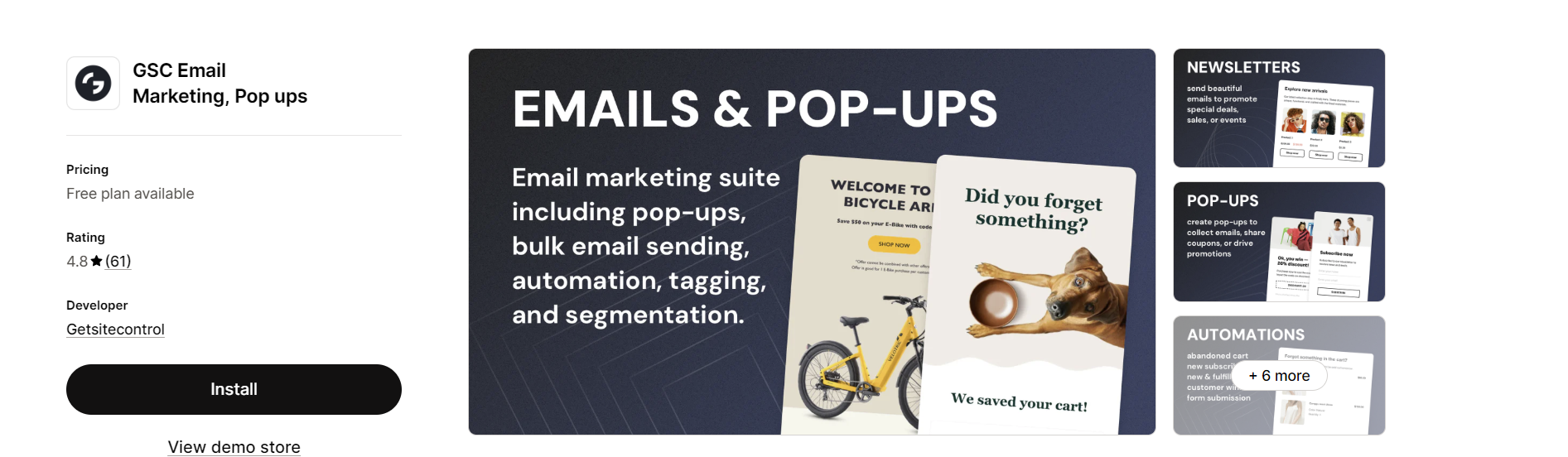
GSC Email Marketing handles everything you'd expect from a Shopify email marketing app, campaigns, automations, segmentation, and adds list-building tools that most platforms don't include. The same tool that captures a subscriber via a popup automatically enrolls them in a welcome sequence. For many Shopify stores, that means replacing two tools with one.
The automation stack covers the essentials: welcome flows, abandoned checkout, post-purchase, and win-back sequences. Built-in deliverability tools, bounce prevention, sender reputation monitoring, are particularly useful for newer domains still building inbox placement. And because pricing is usage-based rather than contact-based, a growing list doesn't automatically mean a growing bill.
Pricing: Free plan available. Paid plans start at $19/month. Email contacts are unlimited on all plans; email sends are charged based on volume.
Brevo PushOwl (formerly Sendinblue)
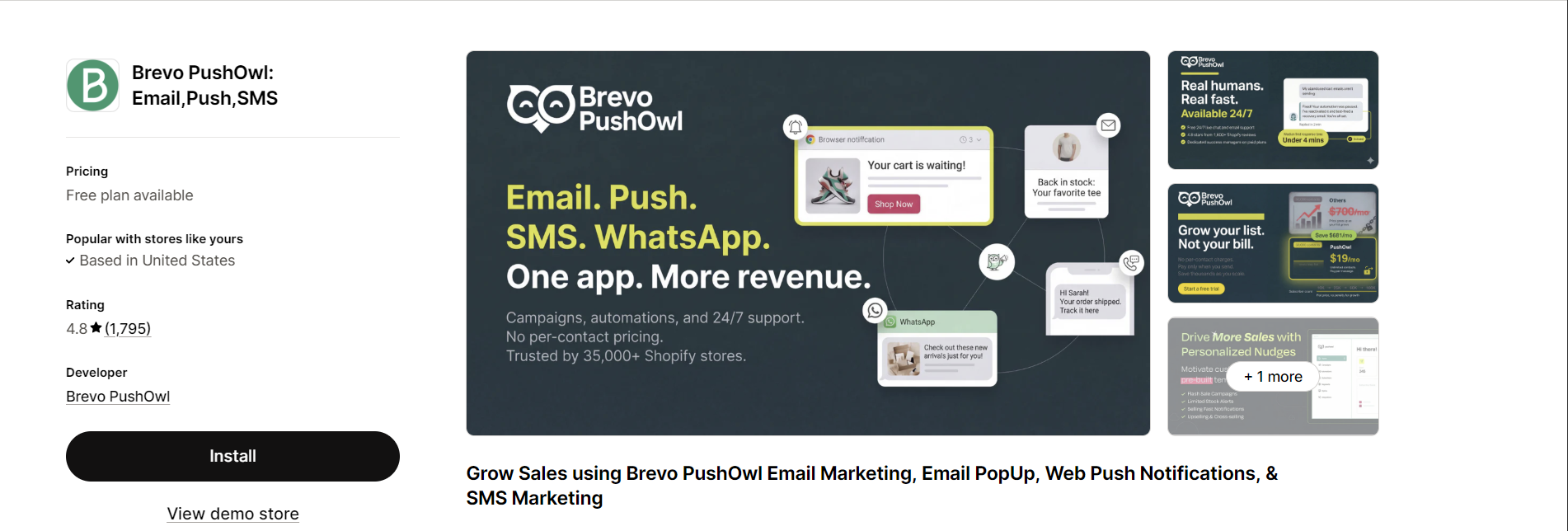
Brevo PushOwl is a multichannel marketing platform that combines email, web push notifications, and SMS marketing into a single app, making it a practical choice for Shopify stores that want to reach customers across multiple touchpoints without managing separate tools.
The automation stack covers the full ecommerce range, abandoned cart recovery, back-in-stock alerts, price drop notifications, welcome sequences, and post-purchase flows, all available through a visual workflow builder with pre-configured recipes you can activate in one click. Your Shopify products, collections, and customer orders can be added to email campaigns directly via dedicated product blocks.
Pricing: Free plan available. Paid plans start around $19/month, with unlimited contacts and additional automations.
Seguno Email Marketing
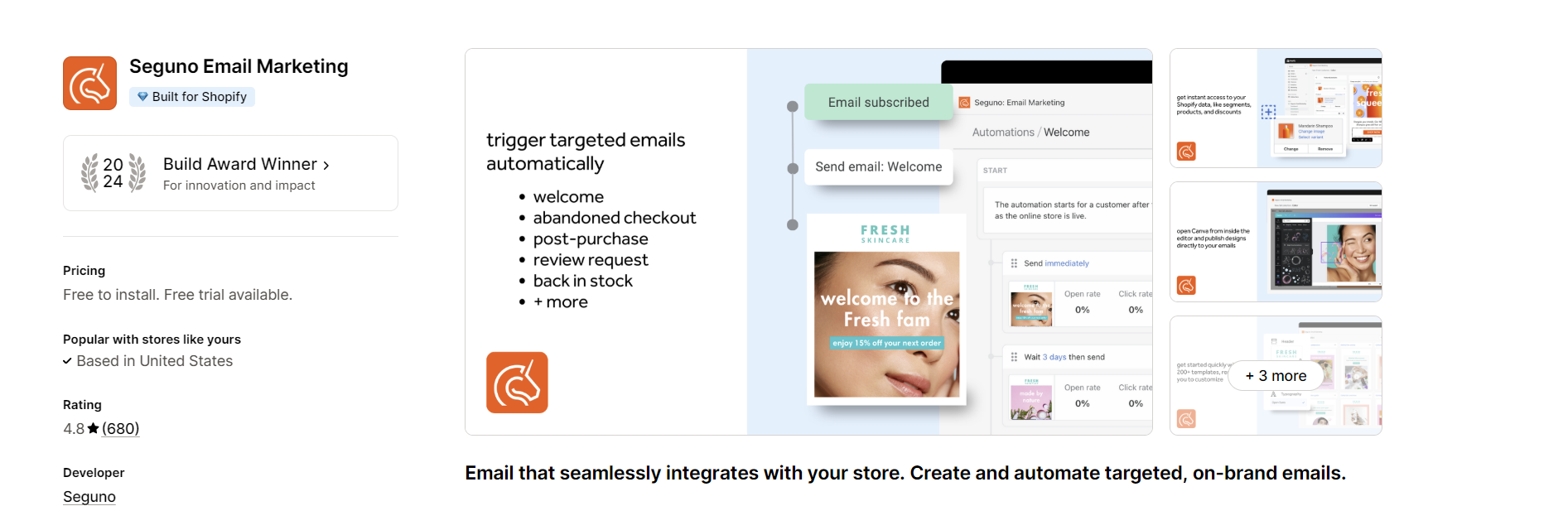
Seguno carries the Built for Shopify badge, Shopify's own quality standard, and it shows in how the app is built. Everything runs inside your Shopify admin: campaign creation, automation, analytics, and even product reviews. There's no separate platform to learn and no syncing to worry about.
Seguno handles the essentials well: welcome sequences, abandoned cart, and back-in-stock notifications, with pre-built workflows that handle the logic so you don't have to build from scratch. The embedded Canva editor is a standout feature for stores that care about design, you can create on-brand email graphics without leaving the builder.
Pricing: Free plan for up to 250 subscribers. Paid plans begin at $35/month for up to 2,500 subscribers, with pricing scaling with list size.
The right email marketing app is the one you'll grow with
The market shift that's prompted this reassessment is ultimately useful. It's forcing a more deliberate decision than most merchants made the first time around, when the default was Mailchimp because it was free, or Klaviyo because everyone else was using it.
If you're not sure where to start, matching the platform to your store's current stage is the fastest way to narrow the decision.
The right platform isn't the one with the most features or the most generous free tier. It's the one you'll actually use consistently, because it fits how your team works, scales with how your list grows, and doesn't require a migration the moment your store hits its next milestone. Make that decision once, make it deliberately, and move on.