
Black Friday doesn’t create business problems. It finds them.
A slow inventory sync you can live with in March becomes oversold stock in November. A courier cutoff nobody wrote down turns into a pile of late parcels. A promotion that looked great in the planning meeting brings in thousands of orders at a margin that barely covers the packaging.
When demand spikes, every weak spot in your operation gets tested at once. You can’t control the economy, the weather or what your competitors charge. But you can control how ready your systems, your stock and your people are when the orders start landing.
That was the thread running through our latest eCommerce Explored webinar, Holiday Ready or Holiday Reactive? Building Retail Resilience Before Peak Season, sponsored by Brightpearl by Sage. Chloe Thomas brought together an ops expert, a retail systems specialist and a marketer to talk through what being peak ready actually looks like.
Meet the Panel
Kathleen Sullivan Garman is Founder and CEO of SullyGarman & Associates. She works as an outside head of operations for eCommerce brands, finding the places where they’re quietly losing profit. She started out as a brand founder herself before moving into consulting after a number of exits.
De Ana Palladino is a Solutions Consultant at Brightpearl by Sage, where she digs into retailers’ tech stacks and workflows to help them win their peak season. She spent over eight years in retail at Kohl’s and Bloomingdale’s, then ran six stores and the eCommerce site for a family-owned children’s clothing brand across Long Island and New York City.
Lisa Wendland is Head of Media at Blue Wheel, where she leads retention, discoverability and creator-led growth. She has more than 15 years in digital marketing and teaches as an adjunct professor at Cleary University.
Peak Season Is a Stress Test for Your Foundations
De Ana opened the session with a simple idea. Peak shines a light on how solid your business really is underneath.
“When demand spikes, you’re definitely going to start seeing the cracks in your foundation,” she said. Those cracks show up in customer service, fulfillment turnaround, or marketing that promises more than your stock and deliveries can support.
Every retailer sells different products to different customers. But De Ana said the brands that keep growing past the Q4 spike all get the same basics right:
- Their marketing matches what’s actually arriving in the warehouse and on the website
- The right goods are in the right place at the right time
- They know their true margins, so a boom in sales doesn’t quietly wipe out profit built up through the year
Kathleen agreed and put it more bluntly. “The worst thing you can be in eCommerce is reactive.” Being proactive comes from data, and good data comes from systems that talk to each other. Every gap between your tools is another place for information to break.
Lisa called peak “the stress test.” If inventory, merchandising, conversion and fulfillment data aren’t joined up, you don’t have the full picture you need to keep things running or keep customers happy.
Too Late to Change Your Tech Stack? Walk Your Floor
The webinar ran in early October, and De Ana was honest about the timing. For most brands, it’s too late to swap out a major system before Black Friday. That doesn’t mean there’s nothing left to do.
She learned this at Kohl’s: walk your floor every single day.
For an online store, that means walking your hypothetical floor. Go through your website as a customer. Search for your products in a browser and check that your brand shows up. Look for products that sold out overnight but still look available. Then ask your team to do the same walk and report back.
“Things happen so quickly overnight, especially during peak season,” she said. If your tech stack can’t alert you to a problem, your own eyes can.
Chloe added that this should be the first job of every day, at minimum.
Run a Fire Drill Now, Then Freeze Everything
Kathleen challenged the idea of “getting ready” for peak. The day of the webinar was also Amazon’s October Prime event, and she pointed out that many brands now see October sales on a par with late November.
“You’re not getting ready for peak. You are in peak right now.”
Her plan has two stages.
Stage one is the fire drill. Push high volume through every connection and try to break it. Test your integrations. Test how your inventory feed behaves under load. Test the connection between your WMS and your warehouse. Check that your safety stock buffers are in place and your carriers are ready.
Stage two is the freeze. Kathleen tells brands to lock everything down by mid-October. After that, nothing new goes live. The only changes allowed are fixes to things that are broken. Between mid-October and mid-December, there’s simply no time to test anything.
She also had a very practical tip: print your carrier cutoffs in huge letters and put them up in the warehouse so everyone knows what has to be packed by when. “If an order is four hours late, it’s no big deal. A customer doesn’t even know. But if it’s four days late, you’ve lost a customer and you’re going to get a bad review.”
If you’re reading this after mid-October and haven’t frozen yet, the advice still stands. Test what you can this week, then stop changing things.
Plan for When Things Go Off Script
Lisa’s top piece of advice was to “stop treating peak like a campaign and treat it like an operating system.”
Your calendar tells you what you hope will happen. Your peak strategy should tell you what to do when it doesn’t. The brands going into Black Friday with the most confidence have already decided what they’ll do if:
- A hero SKU sells out early
- Demand comes in 40 to 50% above forecast
- Customers end up on backorder and won’t get their gift in time
Lisa has worked with brands that didn’t plan for these moments. Her job then is to step in fast and work out what to tell customers, and how to keep them loyal even when they’ve been let down. Getting ahead of it is far easier. Look at the customer journey end to end now, including product details, shipping expectations and the messages you’ll send if something goes wrong.
The Post-Purchase Team Decides Whether Peak Was Profitable
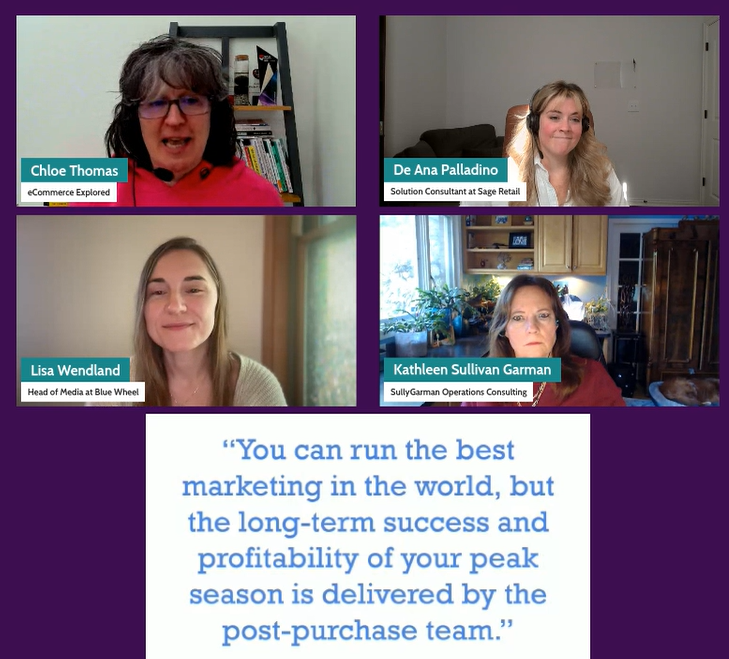
Chloe put a statement to the panel. You can run the best marketing in the world, but the long-term success of your peak is delivered by the post-purchase team: the people picking, packing, running customer service and chasing couriers.
Nobody disagreed.
Keep Your Seasonal Team Informed and Happy
De Ana pointed out that many retailers are hiring seasonal staff right now, people who’ll only be with them for a few weeks. That means overcommunicating, even when you feel you’ve said it enough.
It also means bringing some holiday cheer into the warehouse. At Bloomingdale’s and Kohl’s, she saw teams turn order targets into games, like tracking how many packed orders it would take to “travel” all the way to California. Small rewards and a bit of fun go a long way. “If a happy team is packing, then they’re going to take more care,” she said.
Chloe agreed. Most of the year, warehouse talk is all step counts, pick locations and automation. When you’re slammed, sometimes what you really need is cake in the break room.
She added one more tip: don’t treat everyone in the warehouse the same. Give new starters the simple single-item orders. Move your most experienced people to the jobs where their knowledge counts most.
Marketing Wins the First Order. Operations Wins the Second.
Kathleen explained why the post-purchase experience matters so much to the bottom line.
During peak, profit per order drops. Brands have bought extra stock, added warehouse staff and spent heavily on promotions. They’re betting that a good share of those new customers will come back and buy again. “The marketing team brings in that first order, but the operations team brings in the second order,” she said. If too few customers return, the whole season can lose money. That second order, often placed in January or February when things are quieter, is a big part of how profitable the year really was.
She also said marketing and ops working together can create sales. If the ops team tells marketing they’ve got extra stock of one SKU or a better price from buying in volume, marketing can bundle it, lead with it or promote it.
Lisa added that a great delivery experience can turn a gift buyer into a long-term customer who comes back to buy for themselves. “Some of the best marketing is about how that product got to you and the care that goes into it.”
Which Metrics Should You Watch During Peak?
Chloe’s next statement was that customer lifetime value (CLV) is the most important peak season metric. The panel pulled it apart, and she happily admitted it.
Lisa said no single metric deserves that title. CLV is useful because it looks past one transaction, but it has to sit next to profitability. She’d look at channel performance and campaign revenue first, then dig into customer quality, order counts and averages.
Kathleen called CLV “the outcome of peak” rather than something you can track during it. “You’re not going to know in November what that is. You’re going to know next fall.” She also warned that customers who buy on discount will expect a discount next time, so you have to win them over by keeping your delivery, quality and service promises.
Instead, Kathleen tracks:
- Contribution margin per order. Is each order making money today?
- Order exception rate. An early warning that fulfillment is starting to break
- On-time shipping against your promise. Are you doing what you told customers you’d do?
- 90-day repeat rate. Are new customers actually coming back?
De Ana added gross margin return on investment (GMROI). Her question was simple: did we end up giving away the farm for free? Loss leaders are fine, but you still need enough cash after peak to pay for spring and summer stock. Many retailers are placing January and February purchase orders right now, so the margin you protect in November pays for the months that follow.
Chloe summed it up. Let CLV guide how you run peak, but if you run it purely for lifetime value, you’ll have no margin left by February. “You need to generate enough cold hard cash to see you through the next nine months. Otherwise, there will be no peak 2027.”
Three Black Friday Tips From the Panel

Make the Offer Simple (Lisa)
Shoppers are overloaded. They’re wondering if there’s a better deal coming, whether they trust the brand, and what the small print means. All of that hurts conversion. Lisa’s advice is to keep it simple: a clear offer, an obvious hero product, and a strong reason to buy from you rather than anyone else selling the same thing. Customers shouldn’t need a calculator to work out whether your deal is worth it. Free shipping, even with a spend threshold, still works.
She’s also a big fan of teasing your sale early. Ask shoppers to sign up for VIP early access, then use that list to learn who’s most excited and what they’re looking at. One of her favorite tactics is a “stock your cart” email that encourages customers to fill their basket ahead of the sale. She’s seen shoppers go back to that email days or even weeks later and convert straight from it.
Shop Your Competitors (De Ana)
You can’t convince customers you’re the best option if you don’t know what everyone else is offering. De Ana’s tip is to shop your competitors early so you can respond to their promotions proactively instead of reacting to rumors. Or as she put it: “Walk your floor, then walk their floor.”
Set Up an Exceptions Desk (Kathleen)
Kathleen’s tip could save your whole season. Take your best ops person off the floor and give them one job: own the exceptions queue, and check it every hour from now until mid-December.
“Your dashboards are going to tell you what your sales are, but the exceptions queue is going to tell you what is about to be a customer service problem.” That means bad addresses, payment holds, inventory mismatches, SKUs that aren’t mapped at the 3PL, and integrations that have quietly stopped working. Catch them early, and that person becomes the hero of your peak.
She shared a story that shows why this matters. At one high-volume brand she worked with, Shopify stopped charging credit cards for around four hours, leaving thousands of orders stuck. A customer service team member spotted it. The whole company, including the CEO, then spent the day manually charging cards on every order until the issue was fixed. “You got to be ready, but someone’s got to be watching.”
The Key Takeaways for a Profitable Peak
Chloe closed by asking each panelist for the one thing brands should take away.
Lisa: Think beyond the promotional calendar. Build the system that creates demand and keeps it going all year, so customers come back, become advocates, and even refer their friends.
Kathleen: “Sales and marketing are going to drive your revenue. Operations is going to drive your profits. You cannot sacrifice one for the other.” Ops needs to talk to finance about costs, and finance needs to talk to sales about pricing. Peak is just one part of a full year of data.
De Ana: Control your controllables as far as you can, and keep asking for feedback from every level of your team. The people closest to the work will spot problems first.
Watch the Full Session
There’s plenty more in the full recording, including the back-and-forth between the panel that a recap can’t capture. Watch the full webinar replay on YouTube.
Want more Black Friday prep? These will help:
- The 7 Easy to Setup Tools You Need for Black Friday/Cyber Monday
- How to Manage Cash Flow During the Black Friday Busy Season
- Why Siloed Marketing No Longer Works: Building Connected Growth Systems in 2026 (by our panelist Lisa Wendland)
Join Our Next eCommerce Explored Webinar
eCommerce Explored brings brand decision-makers together with experts to tackle the questions you’re wrestling with right now, live, with time for your questions. Sign up for upcoming eCommerce Explored webinars so you hear about the next session first.
A huge thank you to Brightpearl by Sage for sponsoring this session.