

Server-side tracking has become one of those phrases that makes ecommerce teams feel like they're already behind. If you run a Shopify or WooCommerce store, there's a decent chance someone has told you that you "need" server-side GTM, server-side tracking, or a first-party tagging setup to fix your attribution, recover lost conversions, and make GA4 accurate again.
Sometimes that's true. Often it isn't.
Server-side tracking has a real place in modern ecommerce measurement. But it's also being oversold to stores that haven't yet fixed far more basic problems: broken GA4 ecommerce events, duplicate purchases, poor consent setup, missing Google Ads conversion actions, bad Meta event matching, inconsistent checkout tracking. Server-side tracking can improve a good measurement setup. It won't magically rescue a bad one.
What server-side tracking actually does
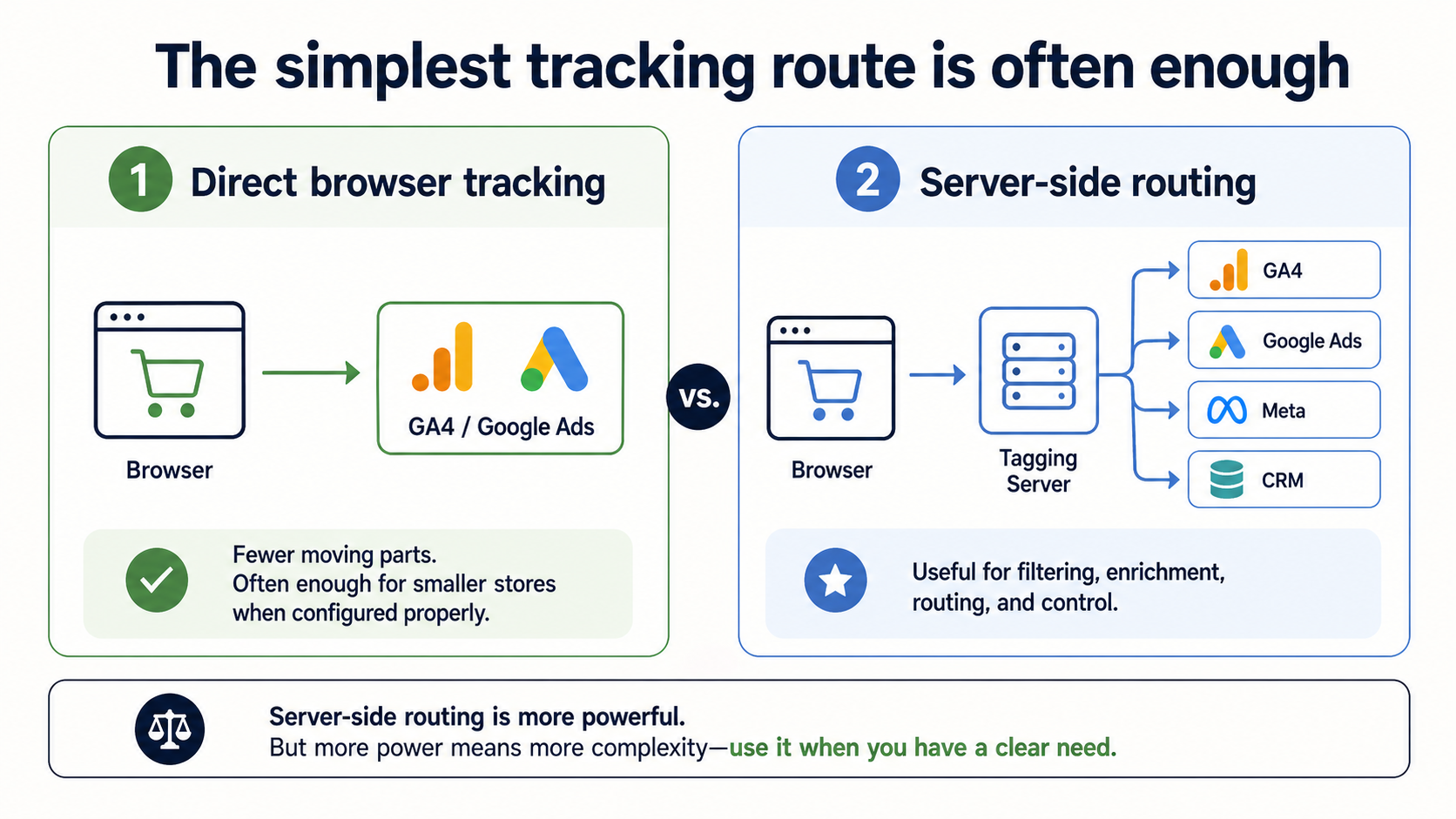
Most ecommerce tracking is still client-side. Tags fire in the browser — GA4, Google Ads, Meta Pixel, Microsoft UET, TikTok, affiliate scripts, heatmap tools, the lot.
Server-side tracking changes the route. Instead of every vendor receiving data directly from the browser, events go first to a server-side endpoint. From there, the data can be cleaned, enriched, filtered, and routed to different platforms.
That can be genuinely valuable. A good server-side setup reduces third-party JavaScript running in the browser, gives you more control over what data is sent to each vendor, and supports more advanced routing into ad platforms, analytics tools, CRMs, and data warehouses. For larger ecommerce businesses, those benefits can justify the cost.
The problem isn't server-side tracking itself. It's the way it's often sold.
The pitch ecommerce brands are hearing
The most common sales pitch is simple:
"You're losing conversions because browsers, consent rules, and ad blockers are blocking your tracking. Server-side fixes that."
That pitch is attractive because it sounds like a technical upgrade with a clear commercial outcome. Lost data comes back. ROAS improves. GA4 looks healthier. Everyone relaxes.
But the framing hides a lot.
- First, some loss of tracking isn't a technical bug. It's the result of user choice, browser privacy controls, consent requirements, and platform limitations. Treating all of that as something to "recover" can take you into questionable territory.
- Second, even when server-side tracking improves signal quality, it doesn't automatically make your data accurate. If the source event is wrong, the server will faithfully pass on the wrong event.
A duplicate purchase event is still duplicate server-side. A badly mapped GA4 item array is still badly mapped server-side. A checkout event firing at the wrong step is still wrong server-side. You've just given the bad data a more expensive journey.
Shopify and WooCommerce already have simpler routes for many stores
Many ecommerce stores don't need a full server-side GTM setup on day one, because their platform ecosystem already offers simpler options.
On Shopify, the official "Facebook and Instagram by Meta" app can use Meta's Conversions API when data sharing is set appropriately. Shopify also has a pixel framework where apps can use web pixels, and certain app owners can use server pixels. That's not the same as a complete server-side tracking setup out of the box, but it does mean many merchants can get useful platform-specific server-to-server signalling without building a full server-side GTM stack.
On WooCommerce, the situation is more plugin-based. Google's own setup route uses the Google for WooCommerce plugin. For more tracking-focused setups, tools like PixelYourSite can work with ConsentMagic to manage tracking and consent together. Again, not the same as a full server-side GTM container; it's a more focused, lower-maintenance route for stores that mainly need reliable ecommerce tracking into major ad platforms.
A platform app or plugin isn't as flexible as server-side GTM. It won't give you the same control over data transformation, multi-vendor routing, or custom first-party pipelines. But for many stores, it may be good enough. And "good enough, maintained by the platform ecosystem, and understood by the team" is usually better than "technically superior, expensive, and badly maintained."
For many smaller stores, the purchase event is the commercial core. If purchase tracking is clean, deduplicated, and consent-aware, you may not need a full server-side stack at all.
The ad blocker question
One of the more uncomfortable parts of the server-side tracking conversation is ad blocker bypassing.
Some server-side setups are promoted as a way to recover data that would otherwise be blocked. That sounds commercially useful, but it's not always a healthy direction for the industry.
Simo Ahava, one of the most respected voices in the GTM community, has publicly warned against using server-side GTM to bypass ad blockers. His point is worth taking seriously: if users have taken deliberate steps to block tracking, building around that choice is about ethics and legality.
That is especially relevant in the EU and UK, where cookie consent and privacy rules are a much bigger part of the measurement conversation. If someone is blocking ads or tracking, you should be very careful about treating that as data to recover rather than a signal to respect.
That doesn't mean server-side tracking is bad. It means "recover blocked traffic" shouldn't be the headline reason for doing it. The better reasons are data governance, control, performance, routing, and reliability. Also, those only matter when the business genuinely needs that level of sophistication.
When server-side tracking does make sense
Server-side tracking earns its place when the business case is clear.
Higher-volume stores often see the strongest case. When small improvements in signal quality have a material effect on bidding, reporting, or budget allocation, the infrastructure overhead becomes worth it. The same logic applies to brands running heavily across Meta, Google Ads, and multiple paid channels where controlling deduplication between browser and server events genuinely moves the needle.
If you're routing first-party event data into several destinations at once (analytics, ads, CRM, email, data warehouse), server-side is often the right architectural choice. And if too many client-side scripts are dragging site performance, with a real plan to reduce browser-side vendor load, server-side can solve that too.
One scenario that tends to get skipped in the sales pitch: your team or agency actually has the skill to monitor and maintain the setup after launch. Server-side tracking isn't set-and-forget. It adds infrastructure, ongoing cost, and another place where data can quietly break. That needs to be owned by someone.
A checklist before you say yes
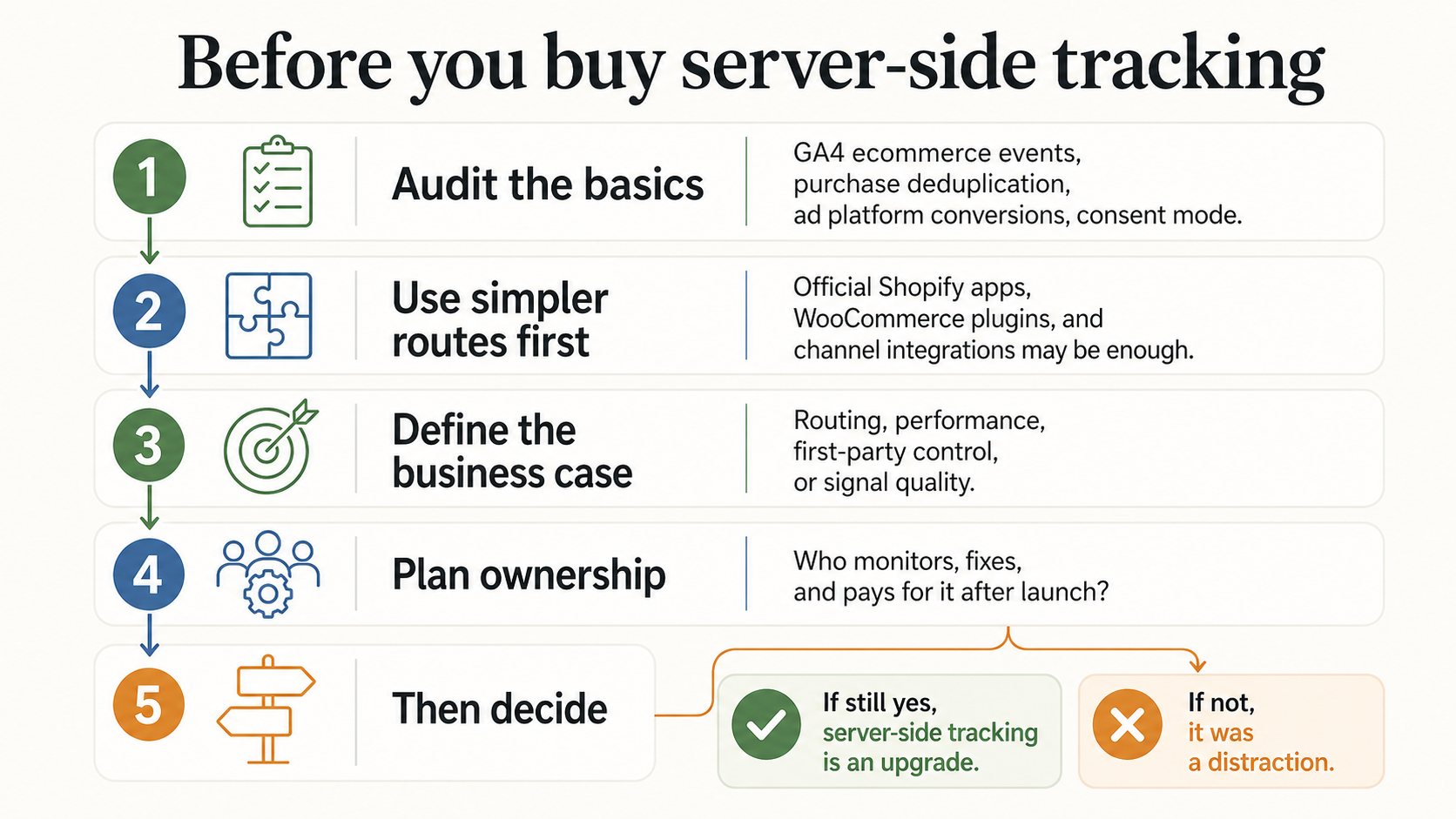
Before approving a server-side tracking proposal, ask these:
- What specific problem are we solving? Attribution accuracy, platform signal quality, page performance, data control, consent governance — these all need different solutions. If the answer is vague, that's a warning sign.
- Have we audited the current GA4 and ad platform setup first? If not, do that before adding infrastructure.
- Which events will be sent server-side, and why? "All tracking" is not a plan.
- How will browser and server events be deduplicated? This matters especially for Meta and purchase events.
- What will this cost to run and maintain? Include hosting, platform fees, agency fees, QA, and ongoing monitoring.
- What happens if it breaks? Someone needs to own the setup after launch.
- Could an official app, plugin, or simpler platform integration solve 80% of the problem? For many Shopify and WooCommerce stores, the honest answer is yes.
Getting the order right
Server-side tracking isn't a waste of time. It's not snake oil, and ecommerce teams shouldn't dismiss it. But it's often being sold too early.
Most stores should fix their measurement foundations first — GA4 ecommerce events, purchase deduplication, ad platform conversions, consent setup, channel-specific integrations. Once those are clean, server-side tracking becomes a strategic upgrade rather than an expensive attempt to patch over bad data.
The best measurement setups aren't the most complex ones. They're the ones the business can trust, maintain, and act on.
For some ecommerce stores, that may eventually mean server-side GTM. For many, it means getting the basics right first and using the standard platform plugins.